Wednesday, November 18, 2009

Transparent Things


From the first page of Transparent Things, I was addicted. By the end I was, as I typically find myself in relation to Nabokov, astounded by the weight of all the many references. How could there be so many connections in so short a novel! Even this tiniest of masterpieces is complete and alive. Yet I know I have only scratched the surface. With Nabokov, I am always just beneath the surface, no matter how deep I go.

What struck me about Transparent Things was this major thread running through it, a thread that is present even in the title. The first page alone is so beautifully representative of the whole. Each object is transparent, revealing entire histories and connotations that build upon themselves until we find ourselves holding, not just a mere wooden pencil, but a part of every link in the chain of progression, a part of a living tree. There is this limited "reality" superimposed over everything we see and touch, even people. The narrator of this first page seems to say that if we want to remain in this "reality" or tied to the "real" world, we must learn not to focus too much on any object, lest we lose ourselves in these eternities. Our whole lives are spent searching for meaning. Simple objects trigger memories; a teacup or a cookie finds its way into our hands and suddenly entire worlds open up before us.


Is there any such thing as ultimate "reality" in the end? The narrator states "One should bear in mind, however, that there is no mirage without a vanishing point" (553). This seems to imply that absolute truth is attainable, beneath the transluscent layers of time, memory, perception, connotation, definiton. Or perhaps we only loop back upon ourselves, like a great Mobius strip, ending where we began and starting already complete.


With every book we've read this semester, upon reading the final lines, I always, quite involuntarily, find myself cycling back to the first words for greater connection. To be a good reader, we have to reread. That is the only thing I want to do when I reach the supposed end of a novel by Nabokov. I have been trapped in this web....of illusion and immortality, sense and coincidence.


As a quick side note, I did a little research into the line in French on page 507 and found some interesting connections. The line reads, "Ouvre ta robe, Déjanire that I may mount sur mon bûcher."


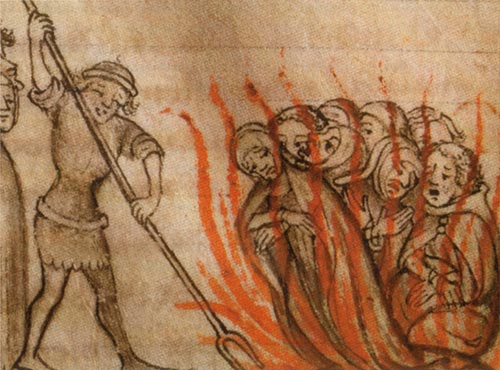
The words "Ouvre ta robe" means roughly open your dress (garment), and the word "bûcher," according to a translated French Wikipedia article, refers to bonfires as were used to burn criminals at the stake.


A little research into the name Déjanire revealed that this name is a reference to the wife of Hercules who, as the legend goes, offered him a cloak soaked in the mystical blood of a centaur whom the hero had defeated in order to keep her husband from leaving her. Little did she know that the cloak was poisoned. The cloak burned Hercules so badly that he then threw himself into a funeral pyre.
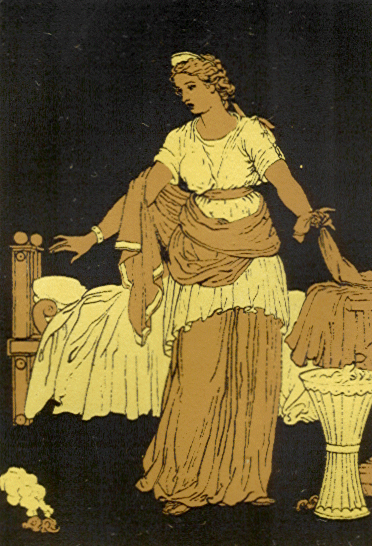


So, with these references in mind, the line that Hugh Person pens in his journal to Armande reads "Open your robe, wife of Hercules, that I may mount my funeral pyre". Person's love of Armande will lead to his demise. Remember that he dies by fire in the end. Deianira, of Greek mythology killed herself by hanging herself. Armande dies by strangulation.

Monday, November 2, 2009

Verlaine Discovery


On page 170 of Pale Fire, there is a tiny, seemingly offhand reference to "an old bearded bum, . . . who stood like a statue of Verlaine". I was interested in that single word, Verlaine, and took to the internet hoping to find some statue or impressive sculpture to feed my artistic appetite. What I did find surprised me.


Verlaine refers to the French poet, Paul Verlaine of the late 1800s. His short biography (linked above) states that his first wife was named Mathilde Mauté. A little research revealed that over time, the name Mathilda which means powerful in battle, was shortened to form the name Maude. Here we see the specter of Aunt Maude coming back to us once again from her literary grave. After Verlaine's love affair with Mathilde burned out, he eventually fell in love with his student, Lucien. Lucien means, in Latin and in Greek, "light".


Verlaine was a "Symbolist leader" through his many poetic works. After sifting through some of his many beautiful pieces, I stumbled upon La Bonne Chanson. La Bonne Chanson is a collection of poems Verlaine originally dedicated to Mathilde. In several of these poems I found COUNTLESS references to pale and to fire, even to shade. I have copied one I found to contain the most references; it is titled "Since Shade Relents". I have italicized the words that, to my eyes, harken back to Shade, Hazel, and Pale Fire.


Since shade relents, since ‘tis indeed the day,
Since hope I long had deemed forever flown,
Wings back to me that call on her and pray,
Since so much joy consents to be my own, —

The dark designs all I relinquish here,
And all the evil dreams. Ah, done am I
Above all with the narrowed lips, the sneer,
The heartless wit that laughed where one should sigh.

Away, clenched fist and bosom’s angry swell,
That knave and fool at every turn abound.
Away, hard unforgivingness! Farewell,
Oblivion in a hated brewage found!

For I mean, now a Being of the Morn
Has shed across my night excelling rays

Of love at once immortal and newborn, —
By favor of her smile, her glance, her grace,

I mean by you upheld, O gentle hand,
Wherein mine trembles,--led, sweet eyes, by you
To walk straight, lie the path o’er mossy land
Or barren waste that rocks and pebbles strew.

Yes, calm I mean to walk through life, and straight,
Patient of all, unanxious of the goal,
Void of all envy, violence, or hate
It shall be duty done with cheerful soul.

And as I may to lighten the long way,
Go singing airs ingenuous and brave,
She’ll listen to me graciously, I say, —
And, verily, no other heaven I crave.


The piece is filled with references to light and dark, to immortality, even to imagined enemies rising up "knave and fool at every turn". I encourage my reader to consult the hyperlink to La Bonne Chanson to find more poems, many of which reference shade. In "Before Your Light Quite Fail", Verlaine speaks of a "paling star." One stanza starts " Turn on the poet’s eyes/
That love makes overrun—" Shade is our poet, crying over his departed Hazel. In this same poem, further lines read, "Your glance, that presently / Must drown in the blue morn;". Not only does Hazel drown, but also remember, the sea drowns the moon and her ghostly fire.


Another famous French artist, this time a singer called Charles Trénet, formed a tribute to Verlaine's "Chanson d'Automne" (song of autumn) in his song entitled Verlaine or Le Chanson d'Automne.


After looking up the lyrics for this song and putting them into a free translation website, I found this crude, but accurate, translation of the French lyrics:


"Les sanglots longs Des violons De l’automne Blessent mon coeur D’une langueur monotone Tout suffocant Et blême, quand Sonne l’heure Je me souviens Des jours anciens et je pleure Et je m’en vais Au vent mauvais Qui m’emporte Deçà, delà Pareil à la feuille morte "


"The long sobs Of The violins Of the fall Injure my heart OF a monotonous languor All suffocating And pale one,when Rings the hour I remember old days and I cry And I leave For The bad wind That takes me on this side,beyond Similar to the dead leaf"


In this piece as well, we find references to a "pale one" and also to death.


After following this thread, I was shocked to find that so brief a reference lost in the midst of so many grander and perhaps more "important" references, could contain so much meaning. ... Or perhaps I have been led down yet another false trail and have now become thoroughly deceived, deceiving my reader in the process. I leave any verdict on the matter... up to you.

Odon


I wanted to see if there was any historical reference to the name Odon. My reader will remember Odon was the actor in Zembla who helped Charles Kinbote to escape. A quick google search directed me to this person, Odon von Horváth. Horváth was an extremely influential playwright of the early 20th century. His name, Odon, as the article states, is the Hungarian form of the word Edmund (perhaps a reference here to Shakespeare, yet again?).

One interesting bit of information about Odon is that he lived in constant fear of being struck by lightning. Ironically enough, he died from a falling branch in a thunderstorm.

One of his plays, Faith, Hope, and Charity, tells the story of a young girl in dire financial straits who the cruelty and harshness of this world breaks down. The play opens with her attempting to sell her cadaver for the money to pay off fines. In the end, she jumps into a river to kill herself, but is unsuccessful. She dies just after her rescue when her heart gives out. The story seems to parallel Hazel's story in several ways. However, the most interesting part of the review hyperlinked above, was the playwright's explanation of this tragedy he calls a comedy.

"All my comedies are tragedies --- they become funny only because they are sinister. The eeriness has to be there."

Comedy and tragedy, stand ,paradoxically, united. Hazel's tragic suicide and the beauty of Shade's poetry, unites with a pompous, conceited, purposely misguided commentator and we laugh! As we saw in class on Thursday, the only difference between the cosmic and the comic is a single letter.

Santos Dumont's Demoiselle


Just a quick, perhaps random side note, one of the MANY planes that "King Alfin" crashes is the Santos Dumont Demoiselle, pictured here. It was a plane perhaps similar to this one in which Alfin crashes to his death against the castle walls.

John Shade...

This is my representation of John Shade from Pale Fire. He is standing nonchalantly, as if out for a stroll, hand in pocket, his writing implements at the ready. Note the Atalanta Butterfly in the corner and the red hankerchief in his pocket. The drawing was completed rather quickly, so it could be better, and the pictures don't do it justice, but I gave it a shot. =)
John Shade

Detail of Drawing


Monday, October 26, 2009

Duplicity, Disguise, Disa!


(Orsino And Viola by Frederick Pickersgill)


In class we've spoken on several occasions about duplicity in Nabokov's work. We talked about doppelgangers in realation to Humbert Humbert and Quilty in Lolita. In Pale Fire, we've lightly touched on the subject in reference to the recurrence of mirrors throughout the book, this concept of reflections. Water plays a key role in this. However, it wasn't until Gretchen Minton's visit on Thursday, and her explanation of the influence of Shakespeare on this novel, that I made my discovery.


On page 173 of Pale Fire, this passage caught my eye; Kinbote recalls his first encounter with his soon-to-be-wife Disa: "She had come in male dress, as a Tirolese boy, a little knock-kneed but brave and lovely".


For those of you (like myself) who had no idea what a "Tirolese boy" looked like, here's a video of Tirolese dancers. ( Tirol is a small state in Austria.)


This one line from Pale Fire, seemingly serving only to show Kinbote's homosexual attractions, brought to mind the similar disguise of Viola from Shakespeare's Twelfth Night. Disguise and duplicity play a major role in this play as well. Viola is doubled by her brother Sebastian. Olivia is doubled by Orsino. The list continues for almost every character in the play. Resemblance and this disguising of self manifests itself most aptly in the person of Viola. Here is a woman dressed as a man who then loves a man, Orsino. Homoerotic tendencies can be found in this relationship as well. Orsino says "I'll sacrifice the lamb that I do love" (here speaking of Viola who he thinks is a man) "to spite a raven's heart within a dove" (here speaking of Olivia who he supposedly loves) (5.1.127-128).


Disa disguises herself as a man and loves a man, Kinbote, just as Viola does. However, Kinbote, unlike Orsino, does not end up loving Disa once this disguise is abandoned.


The disguise theme does not stray far from the character of Kinbote himself. He lives in exile, disguised as a professor and all-too-interested neighbor. He escapes Zembla in disguise, wearing a red cap and red outfit. This red echoes the Red Admiral butterfly seen in the last passage just before John Shade's death.


When I researched the meaning of the name Disa, I found that in Greek, it means double. Disa also refers to a genus of orchids. Though they come in several colors, the majority of the pictures I found were red.


(Disa Uniflora)


Thursday, October 22, 2009

Mumblings on 188


This Tuesday in class, Dr. Sexson put the following words (transcribed by Hazel from a supposed ghost) on the board:

pada ata lane pad not ogo old wart alan ther tale feur far rant lant tal told

He asked us to decipher the message, if indeed there was a message before class today. Throughout the period, I continued to stare at the words, trying in vain to divine some pattern. I was, as Kinbote, mystified as to the meaning. Of course, like him, I could make out the words "war" "talant" "her" and "arrant" (the last of which could refer to one line from Shakespeare's Timon of Athens, "The moon's an arrant thief"). We all know this play, Timon of Athens, recurs quite frequently both in Zembla and in the exiled Charles "Kinbote"s new homeland. Could there possibly be a hint here to the thievery inherent in Kinbote's actions? After all, he is now in hiding after having stolen Shade's final masterpiece. The circumstances of John's death alone seem open to question and interpretation.

After following these and similar threads for some time, I hit a wall. Finally, I resorted to googling the words, in effect, I begged to be told how the trick worked. I found it confirmed an offhand notation I had written in my book.

This site highlights the pattern, just as in my book I had found the first part of it by circling, in a row:

pada ata lane

As the site shows, this is but the beginning of the pattern:

pada ata lane pad not ogo old wart alan ther tale feur far rant lant tal told

Atalanta....over and over. The name alone refers to the Atalanta of Greek myth and Ovid's Metamorphoses. Atalanta also, as I found in this article on Brian Boyd's interpretation of Pale Fire, refers to the Atalanta butterfly, this Red Admirable as it is often called, who hovers before John Shade and Kinbote, just before Shade's imminent death. The reference, so early in the notes in connection to Hazel, leads one to believe that this is the foreshadowing of her death, her immortality the soul (psyche) of the butterfly.